

The "Bare" Campsite Program
Kejimkujik National Park and National Historic Site
A bare campsite is a clean campsite where no food, garbage, scented items or cooking gear is left unattended. Keeping a bare campsite is one of your most important responsibilities during your stay at Kejimkujik.
A bare campsite protects campers and prevents wild animals like bears and racoons from being attracted to human food, scented products and garbage. Campers and staff are responsible for ensuring that wildlife attractants are never left unattended in campgrounds or day-use areas.
On this page
- What is a bare (clean) campsite?
- How to keep a bare (clean) campsite
- If your campsite is not bare (clean) when it is unattended or you are sleeping
- Reasons to keep a bare (clean) campsite
- Attention pet owners!
- Report all bear sightings
What is a bare (clean) campsite?
This is a clean campsite
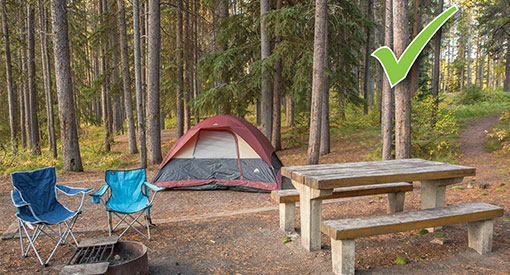
What is right?
- All food, garbage, scented items and cooking gear is stored in a hard-sided vehicle or storage locker while campers are away from their campsite
This campsite is not clean
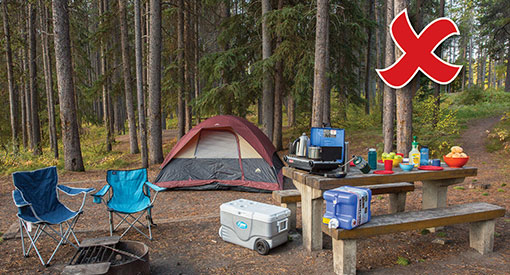
What is wrong?
- All food, garbage, scented items and cooking gear is left outside while campers are away from their campsite
- All items left outside may attract animals which may put campers and animals at risk
How to keep a bare (clean) campsite
By camping in a national park, you agree to store all food and scented items:
- in a hard-sided vehicle, trailer, or motorhome
- in a campground food storage locker
- in the backcountry: with a bear bag or bear canister and bear cables, or in bear-proof/air-tight food containers if tree storage is not an option
You must not leave food and scented items in an open, screened-in or soft-sided shelter such as:
- a tent
- an open back of a truck
- a dining shelter
- a tent trailer
- an oTENTik
This rule applies whenever food and scented items are not in use, including:
- at night while you are sleeping; or
- when you are away from your site for any length of time
When away from your site, you may leave out your camping furniture (e.g. lawn chairs, lanterns and tents).

You must never leave ANY of these items unattended:
- food – open or closed
- garbage, including food scraps
- bottles and cans – full or empty
- coolers – full or empty
- dishes and pots – clean or dirty
- pet food and bowls
- barbeques and camp stoves – clean or dirty
- toiletries
- ANY item associated with food preparation
Always dispose of your grey water in designated sinks, campground toilets or at a sani dump station
- Never dump wastewater on the ground
- Do not drain wastewater at the water taps
Keep your campsite fire box clean
- Fire boxes are not trash cans – animals can still smell and are attracted to food and garbage that has been burned
Clean up spills and crumbs
- Dropped food and drinks, even in small quantities, can attract wildlife
If your campsite is NOT clean
Park staff regularly patrol the campground to ensure that campers have not left anything out at their site that could attract wildlife.
By camping in a national park, you agree that:
- Parks Canada staff may enter open and plainly visible areas of an unattended campsite to remove and secure plainly visible wildlife attractants
If you come back to your site and items you have left unattended are missing, look for a written notice left by park staff. It will contain further instructions.
If you fail to comply with the requirements of the Parks Canada “Bare” Campsite Program, you may
- have your camping permit cancelled with no refund
- be charged under the Canada National Parks Act and Regulations
Reasons for a clean campsite
- By feeding an animal or leaving your scented food items unattended, you attract it to roadsides, picnic areas and campgrounds — this is dangerous for you and for the animals
- Animals can smell your food and scented items
- Anything that has a smell or could be considered food may attract animals
- Animals need to find their own natural food sources, not yours
- A fed bear is a dead bear — wildlife habituated to human food and garbage can be subject to trapping, relocation or destruction
- A clean campsite is a requirement of your camping permit

Report all bear sightings
Please report all bear sightings to park staff immediately.
If the bear is aggressive, threatening, lingers or does not run away
- 1-877-852-3100
If the bear is not threatening, displays a normal fear of humans and runs away
- 902-682-2772 or
- 1-877-852-3100
Related links
- Date modified :