
Rebuilding Guide
Jasper National Park
A guide to rebuilding structures within Jasper townsite following the 2024 Jasper Wildfire
Updated: April 2026

Introduction
The Rebuilding Guide is a starting point for people rebuilding structures lost within the townsite of Jasper during the 2024 Jasper wildfire. You’ll find several steps to consider as you design your rebuild. You’ll also find a summary of the changes that were recently made to the development policies in Jasper to make rebuilding easier, increase the community’s housing supply, and improve the community’s wildfire and climate resilience.
This guide has been updated for the 2026 construction season to provide clear information for every phase of the rebuild. Parks Canada and the Municipality of Jasper continue to refine processes as applications are received and will share updates as rebuilding progresses.
The Jasper Builders Guide (first published in March 2025) is a comprehensive resource designed to help builders, designers, and contractors navigate the rebuilding process in Jasper. The guide covers design standards, permits, fees, operational requirements, servicing standards and additional resources to support your project.

Text version
Phase 1: Get ready to rebuild
- Talk to your insurer
- Think about what you'd like to build
Phase 2: Design your build
- Work on building plans with an accurate site survey
Phase 3: Application
- Submit complete development permit application
Phase 4: Build
Site preparation: Required for Phase 4
- Sifting
- Debris removal and demolition
- Soil remediation
- Site stabilization
- Start building
- Arrange for inspections
Phase 5: Occupancy
Occupancy
This guide is intended as an additional resource and does not replace the requirements outlined in the official policies that apply. In the event of a discrepancy between this document and official policies, the requirements outlined in the official policies shall take precedence.
Rebuilding Inquiries can be directed to jasperdevelopment@pc.gc.ca or (780) 852-6123.
Canadian Red Cross: Resident + Business Support Services
The Canadian Red Cross can provide individualized support to residents experiencing recovery or rebuild challenges, including:
Financial supports – understanding available assistance and options
Insurance policy review & interpretation – clarifying coverage, exclusions, and claims processes
Construction guidance – reviewing bids, contracts, scopes of work, and construction timelines
How to access support: ABRebuild@redcross.ca
Residents can connect directly with an insurance expert or a construction expert to discuss their specific situation.
Where to find more information
If you have questions at any stage of your rebuild regarding land use or architectural policies, permit requirements, or how to submit an application, Parks Canada and the Municipality of Jasper are here to support you.
Rebuilding in Jasper is well underway, and our teams have expanded to meet the ongoing needs of the community. With additional staff and streamlined processes in place, we are actively reviewing applications, responding to questions, and supporting projects across all phases of rebuilding.
We remain committed to working with leaseholders, builders, and designers to support a safe, timely, and successful rebuild. Updated information and resources will continue to be shared through the Parks Canada and Municipality of Jasper websites.
Other resources that may be helpful:
| Insurance information | Insurance Bureau of Canada | |
|---|---|---|
| Contractor support | Public Registry of Builder & Property Information | Home Warranty | Public Registry |
| Canadian Association of Homebuilders | Finding a Renovator | |
| Lease Questions | Parks Canada | jasperrealtymunicipalservices@pc.gc.ca |
| Bylaw Compliance | Municipality of Jasper Bylaw Enforcement | bylaw@jasper-alberta.ca |
| Permit Compliance and Environmental Concerns | Parks Canada | jaspercompliance@pc.gc.ca jasperenvironmental@pc.gc.ca |
| Ongoing Rebuild and Construction Updates | Municipality of Jasper – Engage Jasper Platform | Jasper Rebuild Mailing List Jasper Industry Bulletin |
| Jasper Recovery: Programs, updates, statistics, and rebuilding resources | Parks Canada | Jasper recovery webpage |
| Other Resources | Canadian Red Cross | Alberta Wildfires 2024 |
| Local Community Supports | Municipality of Jasper - Community Supports |
Designing your building
The following steps will guide you as you design your building.
Step 1: Understand what your insurance will cover
If you haven’t already done so, contact your insurance provider and start a claim.
It’s important to consider what your policy includes and what you may need to pay for out of pocket. Review your homeowner’s insurance policy to check the coverage limits and specific details. If you are unsure about the details, contact your insurance provider for a clear breakdown of what’s included. This will help you make informed decisions and avoid unexpected costs as you begin the rebuilding process.
If you have questions, contact your insurance representative or visit the Insurance Bureau of Canada’s dedicated Wildfires and Insurance webpage. You can also call IBC’s Consumer Information Centre at 1-844-2ASK-IBC (1-844-227-5422) or email AskIBCWest@ibc.ca.
Step 2: Consider retaining professionals
Hiring qualified professionals can help you navigate the design and construction process and protect your investment. Before you hire anyone, take time to check their credentials and experience. There are several trusted resources to help you find reputable professionals and understand your rights as a homeowner:
- Building Industry and Land Development Association – Alberta – guidance on rebuilding in Jasper and connections to industry professionals
- Alberta Association of Architects – verify licensed architects and learn what to expect when working with one
- Residential Protection Program – confirm that your builder is licensed
Canadian Home Builders' Association – information on hiring renovators and protecting yourself as a consumer. The types of professionals needed depend on the project. For a new build, you will likely need an architect (or architectural technologist) and a builder. You might also need to hire an engineer if your building has features that need to be engineered for safety features like significant retaining walls, if there are steep slopes on your site, or if your building has underground parking.
Step 3: Start designing your building
Development projects in the Jasper townsite are required to comply with the Land Use Policy and the Architectural Motif.
The Land Use Policy contains specific information related to what a building can look like (e.g., building height, setbacks from property lines) and what the land can be used for (e.g., commercial business, tourist accommodation, residential use, etc.). The document also contains information on parking and landscaping requirements.
The Architectural Motif set out requirements on site layout, and architectural style requirements to protect and promote Jasper’s iconic Mountain Architecture within the townsite.
To start:
- Check the zoning of your property. Review the Town of Jasper Land Use Map to identify what land use district your property is in.
- Review the development rules on the Parks Canada website. This page has information about the rules that apply to different types of development. You can find information about the rules that apply to each of the following types of development:
- Review updated exterior building materials permitted in Jasper. Exterior materials are restricted for wildfire resiliency, and other climate hazards and to preserve Jasper’s mountain architecture.
- Work with your project professionals to design your building, taking into consideration your budget and ensuring your proposed design complies with the Land Use Policy and Architectural Motif.
Have questions about rebuilding? Come talk to a Development Officer.
Book a pre-application meeting with Parks Canada (45-minute time slots) through jasperdevelopment@pc.gc.ca or by phoning 780-852-6123.
Alternatively, have your questions answered during the below times:
Drop-in Sessions
Drop-in Sessions provide answers to questions about development policies and permitting from Parks Canada or the Municipality of Jasper.
In person (15 minute time slots)
Tuesdays: 10:00am – 12:00pm
Parks Canada Administration Office (Train Station)
607 Connaught Drive, Jasper AB
Virtual (15 or 45 minute time slots)
Thursday: 10:00am – 12:00pm
Friday: 1:30pm – 3:30pm
Step 4: Submit permit applications
Once you have reviewed the requirements for your property, the next step is to work with, prepare and submit permit applications.
There are two main permits that you will need to start construction of your new building: a development permit and a building permit. In most cases, the process will be to:
-
Apply for and obtain a Parks Canada Development Permit
An approved Development Permit confirms that a development proposal complies with the criteria and specifications set out in all relevant Parks Canada policies, acts and regulations.
The Parks Canada Development Website includes checklists of information you need to provide based on the type of development proposed. Please make sure you review these checklists carefully before submitting an application. Incomplete applications are one of the biggest causes of delays in reviewing permit applications.
The development permit application is your opportunity to provide the clearest possible picture of the proposed project. The more detailed information you provide, the fewer questions the Development Office may have. Review and approval timelines depend on the quality and complexity of the submission.
-
Apply for and Obtain a Parks Canada Building Permit
A building permit application is reviewed after obtaining safety codes approval and confirms your project complies with relevant provincial building safety codes. A building permit enables you to begin construction.
This webpage has more information on the building permit process, including the application form (PDF, 160 KB) and application checklist (PDF, 143 KB).
-
Obtain occupancy Authorization and Certificate of Completion
When construction is completed, an occupancy authorization is needed before you can move in. The occupancy authorization confirms the building is safe to use and live in.
To get occupancy authorization:
- Complete final inspections with certified safety code inspectors (e.g. building, plumbing, electrical, and/or gas).
- Send all applicable final building and trades inspection reports showing no deficiencies to jaspercompliance@pc.gc.ca.
- Conduct an occupancy inspection with Parks Canada Compliance Officer.
- Fix any deficiencies identified during inspections.
Often, you may receive an occupancy authorization with conditions. This means that you can move in, but you still need to finish some remaining permit requirements. For example, you may need to complete landscaping or obtain a Real Property Report.
Once all permit requirements are complete you will receive a Certificate of Completion. This document confirms your project is done and all permit requirements have been completed.
In 2026, the only development application fees being charged are building permit fees, calculated at $7 per $1,000 of project value. Please contact the Development Office for fee updates in 2027.
Timelines
Projects submitted to the Development Office are reviewed in the order they are received. Review and approval timelines will depend on the complexity of what is being submitted.
The Rebuild Dashboard gives up-to-date insight into rebuilding activity in Jasper after the 2024 Jasper Wildfire. It shows both the pace of recovery and the status of permit work being handled by the Jasper Development Office.
The Rebuild Dashboard includes:
- Community rebuild progress data
- Current average timelines for processing permits
- Phase of recovery for each rebuilding property
- Historical permit data since September 2024
The dashboard is updated regularly to give the public a clear, transparent view of how rebuilding is progressing.
Updated development policies
In preparation for and throughout the rebuild, development policies for the Town of Jasper have been updated. The more significant updates are described below. Please check the Parks Canada website for the most up-to-date version of the Jasper Land Use Policy and Architectural Motif.
These policy updates were guided by the following values and principles:
- Simplify the development review and approval process to make building easier for lessees.
- Rebuild with wildfire in mind, using the latest FireSmart research to improve Jasper’s resilience to fire.
- Increase housing options for Jasperites to ensure our actions now assist with housing supply in the long term.
- Rebuild with climate resilience in mind, supporting our efforts to be a community at the forefront of sustainability efforts.
- Enhance Jasper’s built-form character to ensure the unique qualities of Jasper are maintained.
For more information
Key Changes to make rebuilding easier
Parks Canada and the Municipality of Jasper are working hard to make rebuilding easier for lessees. Together, we’ve reviewed the permitting and development process from start to finish, and have taken action to relax requirements where appropriate and speed up permitting.
Some key policy changes completed to make rebuilding easier include:
- Delaying permit fee increases to reduce costs to the community
- Simplifying permitting by eliminating a requirement for a foundation elevation check
- Reducing compliance deposit requirements to reduce financial burdens on those building
- Relaxing requirements in the R4 (Compact Lot District) to support residents in rebuilding manufactured homes and in replacing older manufactured homes that have reached the end of their life cycle
- Fast-tracking variances for minor deviations from policy and for like-for-like rebuilds
- Adopting a temporary use policy to support temporary work camps, residential occupancy of RVs, and storage of construction materials within the townsite
Key Changes to improve wildfire resilience
Development policies play an important role in keeping communities safe. Specific policies to improve wildfire resilience of individual buildings help reduce the potential impact a wildfire will have on a community.
Buildings lost to wildfires are often first ignited by embers. Once one building catches on fire, it can then spread from building to building across a community. By reducing the susceptibility of a building to catching on fire, the chances of a building—and all the neighbouring buildings—surviving a wildfire are greatly increased.
After the 2024 Jasper Wildfire, review and engagement with Natural Resources Canada on the latest wildfire-urban interface fires best practices, like those adopted in FireSmart guidelines, several key changes were made to Jasper’s development policies to improve the community’s future resilience to wildfire to ensure community safety:
- Prohibiting new wood siding or roofing. Wood will no longer be permitted, with exception of ehavy timber. Metal, fibre-cement board, stucco, and masonry will continue to be permitted as they are less flammable and less susceptible to melting.
- Requiring a 1.5 m buffer zone of non-combustible materials around a home. This protects the space within the ‘immediate ignition zone’ which is most vulnerable to embers.
Under the new policies:
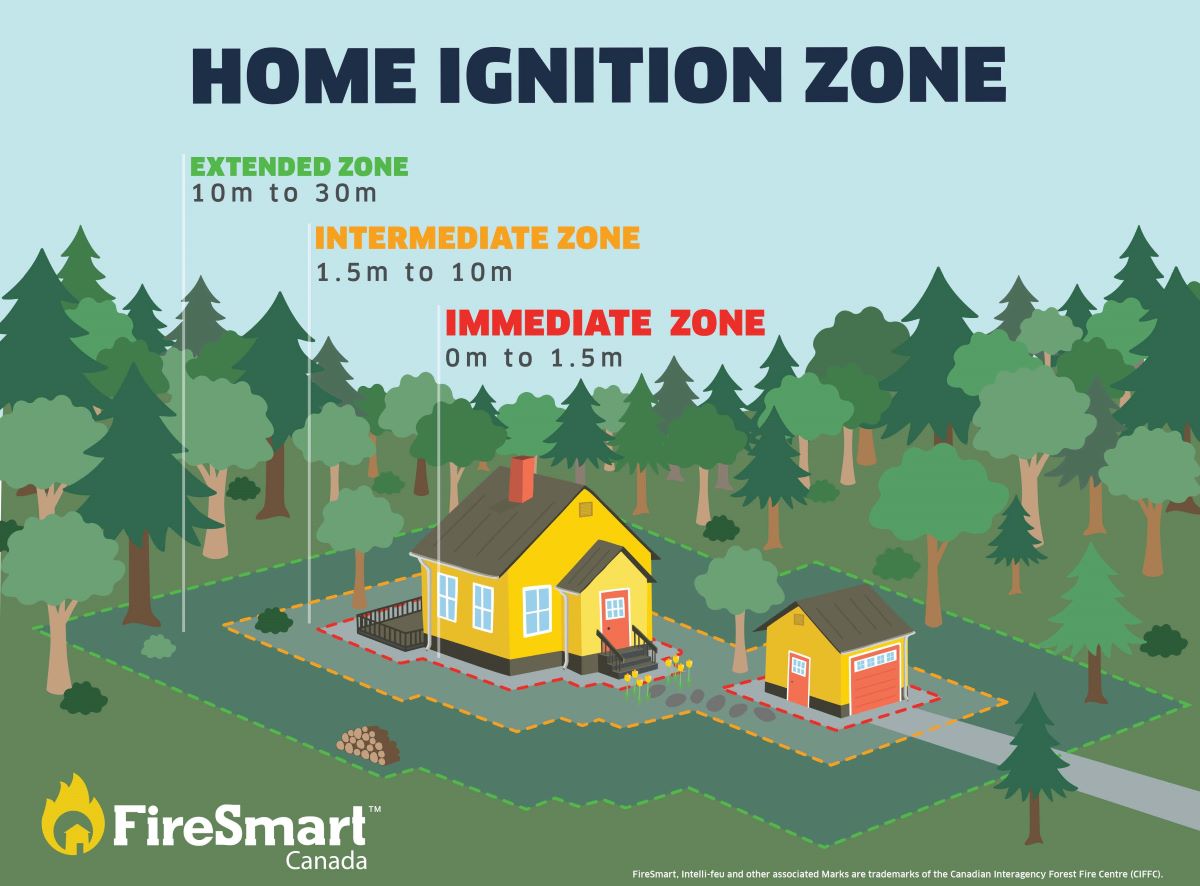
FireSmart home ignition zone infographic
Text version
Immediate zone
- 0 m to 1.5 m
Intermediate zone
- 1.5 m to 10 m
Extended zone
- 10 m to 30 m
- Wooden fences are still permitted, but they must be separated at least 1.5 m from the edge of a structure to reduce the risk of a fence catching a home on fire. This could be managed by having a metal gate or non-combustible panel closest to the building.
- Wooden decks will still be permitted, but decks, porches, or steps within the 1.5 m buffer zone must be made of or surfaced with non-flammable material. The spaces under decks should be kept clear of debris and flammable material and should be skirted to stop debris from accumulating there
- Only non-combustible landscaping options will be permitted within the first 1.5 m of the buffer zone For more information on landscaping requirements and Parks Canada's planting guidelines, please visit Landscaping in Jasper National Park.
- Requiring that new coniferous trees be planted at least 10 m away from a building to reduce the flammability of the yard. This is important because these types of trees are highly flammable and if combustible landscaping ignites it can produce embers that may ignite combustible materials and increase the chance of direct flame spreading to the home.
A word on wood
Wood is an important part of the architecture in Jasper. Plentiful in the early days, it became a common part of the local architecture and an iconic part of important buildings. Since the 1990s, the Architectural Motif largely supported this, promoting wood siding and roofing, wooden detailing and wood’s use in everything from signs to lamp posts.
Wood siding and roofing is a major risk both to individual structures and to the community as a whole and is no longer allowed for new developments in Jasper. This is a significant change and necessary to help protect Jasper in the long term.
Heavy timber log construction, or the use of wood detailing in the form of heavy timbers, is still allowed and aligns with the bold, robust detailing that is emblematic of mountain architecture.
For specific requirements on building materials and colours, including policy requirements and ways to go beyond minimum requirements to integrate FireSmart best practices, please visit Permitted Building Materials and Colours.
Key changes to increase housing
Housing has been a concern in Jasper for many years. Since 2007, the residential vacancy rate for Jasper has been between 0 and 0.4%. Over the last few decades, community consultations have consistently identified additional housing as a priority for the Jasper community.
To create potential for additional housing in Jasper and to give leaseholders more flexibility, the following changes were made to Jasper’s development policies:
- Leaseholders with lots formerly zoned for single-detached dwellings can now build either one or two primary dwelling units on a lot.
Leaseholders still have the option to build a single detached home. - Parking requirements have been reduced.
Under the new rules, only one parking stall is required per primary dwelling unit. Reducing parking requirements creates more space on a lot for housing. Leaseholders can build more parking on their lot if they choose. - More options for accessory dwelling units.
Leaseholders can now build garden suites on residential lots—a source of long-term rental income and increased housing density. A garden suite is a self-contained home that can be built in the rear yard of a residential property instead of a garage. - Subdivision was made easier.
Subdividing one lot into two or more lots that can be bought or sold will be easier in two ways: 1) subdivision is now permitted in areas where it used to be prohibited, and 2) minimum lot widths have been eliminated. This means that leaseholders can now build a duplex, divide the lot in two, and sell the other half of the duplex.
The following amendments were also implemented on February 9th, 2026 in response to recommendations from Municipal Council to support additional housing opportunities within the rebuild:
- Allowed accessory dwelling units (secondary suites, garage suites and garden suites) in more residential zones;
- Increased the maximum site coverage for garage suites and garden suites to improve function and design;
- Allowed both a garden suite and a garage suite on a property, where previously only one of the two was permitted;
- Increased the permitted height of apartment buildings to allow up to four stories, instead of three;
- Increased the eaveline height of multi-unit dwellings in the R3a district;
- Allowed row houses to be integrated into the ground level of apartment buildings;
- Established minimum bike parking requirements and design standards for multi-unit dwellings and apartment buildings;
- Established clearer criteria for evaluating requests for reduced parking for larger-scale residential projects;
- Consolidated requirements for accessory buildings into one section, and standardizing setback and site coverage requirements.
Further details on what changes were made and why can be found on the Town Values & Residential Density and Parking Policies webpage.
What else can I do?
The Architectural Motif and Land Use Policy set minimum expectations for development in Jasper. As a national park community located within a national park and UNESCO World Heritage Site, these rules balance the need for architectural quality with affordability and flexibility for individual leaseholders while also ensuring the unique qualities of Jasper are maintained. If you would like to go beyond the minimum expectations when considering things like FireSmart, climate resilience, housing or architectural character the resources in the next section are available to help.
Rebuild with wildfire in mind
FireSmart Canada has many resources that are available to help residents and landowners develop their properties to help protect them from wildfires. These resources are available on the FireSmart Canada website. Additional information on wildland-urban interface fire best practices specific to commercial and multi-unit residential structures is available. Please contact Parks Canada directly for more information.
Specific resources that might be useful include:
- FireSmart Homeowner Resources
- FireSmart Begins at Home Guide
- FireSmart Home Development Guide
- FireSmart Guide to Landscaping (Second Edition)
Lessees are encouraged to go beyond minimum requirements to implement additional FireSmart best practices for existing and new buildings :
- Install a metal roof on your home or business
- Install vent and exhaust covers with 3 mm non-combustible screening
- Install tempered glass or thermal multi-paned windows
- Install eavestrough covers to stop embers
- Make sure to keep eavestroughs clear of debris and leaves
- Replace your deck with non-combustible materials
- Screen the base of your deck with lattice or non-combustible materials to stop debris and embers from accumulating
- Pick fire-resistant plants identified in the FireSmart Guide to Landscaping and aligned with Parks Canada’s planting lists
- Provide more space between your building and any downslope vegetation
- Clear branches from conifers to a minimum height of 3.0 metres
- Provide a minimum of 3.0 m separation between trees
Rebuild with wildlife in mind
Jasper’s connection to nature is an important part of our community. When rebuilding, your design and landscaping choices can help reduce risks to wildlife and prevent conflicts.
The Architectural Motif includes requirements for building design and landscaping that support wildlife. Some fruit-bearing plants are not allowed in the Townsite, and planting climate-appropriate native species is encouraged.
Consider the following when rebuilding:
- Choose plants that do not produce fruit to reduce wildlife attractants. See the Planting Guidelines for the Town of Jasper (PDF, 160 KB) for a list of acceptable trees and shrubs.
- Plant native species to support pollinators and bird diversity. Native plants require less water and provide habitat and food for local wildlife. The Planting Guidelines include recommended wildflowers and grasses.
- Reduce bird strikes on windows. Glass surfaces such as windows and deck railings can be dangerous for birds. Using etched or frosted glass, adhesive films, or bird-friendly lighting can help prevent collisions. More information is available from FLAP Canada.
Rebuild with climate resilience in mind
Changes have been made to the Architectural Motif to better align building and site designs with best practices in Climate Resilience, but more ambitious climate resilience actions have generally been left to individual leaseholders to implement.
If you want to take climate action and wish to reduce energy costs and improve energy conservation during your building design, some of the following actions can be taken.
- Designing your home to net-zero or net-zero-ready standards can significantly reduce your long-term carbon emissions and also mitigate the impacts of changes in energy costs. Resources from Efficiency Canada are an effective tool to help design your home to Net Zero Standards.
- Consider implementing principles of Passive House Design, which can help to dramatically reduce the heating and cooling needs of your home by implementing higher levels of insulation, actively designing for energy efficiency and taking advantage of sun and shadow on your property.
- Wildfires aren’t the only climate risks that Jasper will face in the coming years, more information on expected climate risks can be found in the Municipality of Jasper’s Climate Risk Assessment Report.
Rebuild with housing in mind
The updated rules for residential buildings in Jasper allow for a wider range of housing options. These options help improve the financial feasibility of rebuilding and allow more housing for Jasperites.
The following section shows some of the housing options allowed in Jasper.
Housing forms: One-Unit Dwellings
Districts allowed: R1, R2, R2H, R3a, R4, CCWa, and CCWb


Housing forms: Two-Unit Dwellings (aka duplex, semi-detached homes)
Districts allowed: R1, R2, R2H, R3a, R4, CCWa, and CCWb


Housing forms: Multi-Unit Developments
Districts allowed: R1, R2, R2H, R4, CCWa, CCWb and CCWc when done in partnership with neighbours and on single lots in R3a and R3b

R3a, R3b: Small Apartments (up to 6 units allowed in R3a)
R3b: Larger Apartments (6+ units)
Questions?
jasperdevelopment@pc.gc.ca or (780) 852-6132
Accessory Dwelling Units
An accessory dwelling is a second, dwelling unit on the same lot primary unit. This can include a secondary suite which is a unit attached to or within the main house or a garage or garden suite separate from the main house. Accessory dwelling units are allowed in all residential districts except the R3b District. In the R4 District, secondary suites are only allowed if the home is placed on a permanent foundation.
A primary dwelling with: Secondary Suite (basement)

Accessory dwellings can also include an apartment over a separate garage (garage suite), or a small home on a foundation in the backyard (garden suite).

In residential districts where Accessory Dwelling Units are a permitted use, a total of two Accessory Dwelling Units are allowed per primary dwelling in the following combinations:
- One Secondary Suite and one Garage Suite
- One Secondary Suite and one Garden Suite or
- One Garage Suite and one Garden Suite
Secondary Suites are not permitted in Multi-Unit Dwellings or Apartment Buildings.

Building a house with an accessory dwelling unit - or designing it so that it has the potential for an accessory unit in the future - can provide additional housing in Jasper and give you potential rental income without adding significantly to your building costs.
Non-residential buildings: If you are building a commercial property, please reach out to the Parks Canada Development Office to discuss site development options for your property.
The Municipality of Jasper’s Clean Energy Improvement Program (CEIP) has a new program to support homeowners in making energy efficiency upgrades by offering financing for up to 100% of the project costs with a fixed interest rate of 3%.
Information specifically for 2024 Jasper Wildfire Rebuilds:
- Clean energy upgrades on properties being rebuilt after the 2024 Jasper Wildfire may be eligible for CEIP if they meet the criteria outlined on the Jasper Rebuild Upgrades page.
- Participants requesting to financing upgrades on properties being rebuilt after the 2024 Jasper Wildfire are asked to reach out to Alberta Municipalities, at hello@myceip.ca, before submitting an online pre-qualification form.
- Up to 40% of each year's budgeted financing will be available for properties being rebuilt after the 2024 Jasper Wildfire.
Accessory Residential Development Program
The Municipality of Jasper’s ADU (Accessory Dwelling Unit) Program offers financial support and tools to help residents build or convert rental units on their property for long term rental. Funded by the Canada Mortgage and Housing Corporation’s Housing Accelerator Fund, the goal is to reduce financial barriers and support long-term housing growth in Jasper.
Grant amounts are in the form of reimbursements for eligible expenses:
- Up to $30,000 for a net new unit (where there was no ADU before)
- Up to $10,000 for a previously built but unpermitted ADU (for example: conversion of PHA to ADU for long-term rental use)
The ADU Incentive Program is available to all Jasper leaseholders—to convert or add to existing buildings or for new buildings—until program funds are depleted.Municipal Administration will monitor program uptake and report back to Council on its success.
Next steps
Rebuilding a home or business can be complicated. Our teams are available to meet with you to answer questions and help guide you through the process. If you need support, please contact jasperdevelopment@pc.gc.ca.
As you use the guide, please provide us with feedback about how to make the guide more useful. Further, if you have questions about how the new development rules apply to your redevelopment, please contact us at jasperdevelopment@pc.gc.ca or (780) 852-6123.
Best wishes to you and your building project!
Frequently asked questions
General questions
How can I get a copy of my lease or the original plans for my building?
Jasper National Park’s Realty and Municipal Service Office is available to assist you. If you need lost documents, such as copies of leases, Real Property Reports and plans, please reach out to jasperrealtymunicipalservices@pc.gc.ca.
I used to operate a home-based business at my property that was destroyed. Do I need to re-apply for permission to operate my business?
Homeowners will be permitted to rebuild and reinstate their home-based businesses and private home accommodations. Permits and licences must still be obtained as part of this process. This ensures continuity for those whose properties were lost, while maintaining the appropriate regulatory oversight. If you have any questions or concerns regarding the reinstatement of your home-based business, please contact the Parks Canada Development Office.
Can I build exactly the same building that I lost?
Similar to before the fire, all new development, even if it is to replace a structure that was destroyed, must be built in accordance with the current Land Use Policy, Architectural Motif, and Safety Codes. This may mean that some structures may not be able to be built exactly as they were before. If you would like to build a similar structure to what you had before, but the current policies would prevent you from doing so, please talk to the Parks Canada Development Office to discuss what options are available to you.
What if I don’t want to or can’t feasibly rebuild?
We understand rebuilding is not the best decision for everyone, please reach out to jasperrealtymunicipalservices@pc.gc.ca or (780) 852-6220 to talk about the options that are available to you.
Do these development policy updates mean I need to make changes to my existing home?
Existing homes are not required to make changes to align with the updated development policies. When it comes time to replace roofs, siding or other areas, depending on the scope of the renovations, as was the case before the wildfire, leaseholders may be required to bring their development into alignment with modern policies and codes.
As always, leaseholders are encouraged to undertake simple maintenance actions like keeping firewood and other combustible materials away from buildings, pruning bushes and trees away from buildings, and regularly cleaning leaves and other combustible materials away from roofs, eaves and under decks.
When will the Municipality take over authority for planning and development from Parks Canada?
Bill C-76, an Act to amend the Canada National Parks Act, received royal assent on October 3, 2024. The bill enables Parks Canada to transfer some of the authorities for land use planning and development to the Municipality of Jasper.
The transfer of specific authorities for the management of day-to-day administration of land use planning and development will take place after a number of steps occur (e.g. establishment of a community plan and land use bylaw). Parks Canada and the Municipality for Jasper remain committed to supporting Jasper through the rebuild process. Parks Canada remains the land use planning and development authority and will continue to accept and consider applications for development in the townsite of Jasper.
What are Parks Canada and the Municipality of Jasper working on next?
Parks Canada and the Municipality of Jasper are committed to the following:
- Continuing to coordinate with builders and contractors in busy rebuild areas and mitigating construction impacts
- Undertaking repairs to municipal and Parks infrastructure damaged by the wildfire (within and outside the townsite)
- Completing the transfer of specific land use planning and development authorities from Parks Canada to the Municipality of Jasper
Residential buildings
I have a double lot—does that mean I can build two homes?
This will depend on how your lease is structured. If you have a single leasehold on a double lot and would like to build a home on each lot, you will need to subdivide your lease. Talk to the Development Office at jasperrealtymunicipalservices@pc.gc.ca for more on this.
Can I subdivide my property?
One of the changes to the Land Use Policy was to remove the minimum site width allowed for each district. This means that where development is feasible, lots and leases could be subdivided to accommodate additional lots and development.
Subdivision involves two processes—subdividing the land and subdividing your lease. For more information on the lease subdivision process and associated fees, please contact jasperrealtymunicipalservices@pc.gc.ca.
Mobile homes
Can I replace my destroyed mobile home with a new one?
Mobile homes are only allowed on lots in the R4 District subject to the Land Use Policies in Article 20. Leaseholders who lost a mobile home are permitted to replace it with another mobile home subject to safety code requirements and the requirements of the Land Use Policy. Mobile homes are not permitted elsewhere in the Jasper townsite.
I want to buy a new mobile home - are there any restrictions I need to know?
In March, 2025 temporary policies were put in place that allow leaseholders in R4 with a mobile home to replace their mobile home with a new manufactured home, regardless of whether or not it was destroyed in the wildfire. These policies are intended to remain in effect until 2030 at which time they will be reconsidered.
The Land Use Policy (Article 20) includes requirements for the replacement of mobile homes that are based on the requirements that were established for mobile homes in Jasper in 1992 and were updated to: a) grant more flexibility to mobile home owners, b) align with requirements for permanent structures in the land use district, and c) align with modern safety codes.
All mobile homes must have skirting around their base covering up the void space under the home. The skirting must be made of non-combustible materials.
Any mobile home placed on a lot in Jasper must comply with applicable safety codes. We strongly encourage you to contact a safety codes officer (PDF, 44 KB) before purchasing a used mobile home to verify it meets the current code. As with all districts, the Land Use Policy establishes restrictions on the size of a mobile home, setbacks, site coverage, and parking to maintain the character of the neighbourhood. To avoid any issues, please do not purchase a new mobile home before confirming that the mobile home meets current building code requirements for mobile homes.
Can I buy a used mobile home?
Any mobile home placed on a lot in Jasper must comply with applicable safety codes, as well as architectural and siting requirements. We strongly encourage you to contact a safety codes officer (PDF, 44 KB) before purchasing a used mobile home to verify it meets the current code and to talk to a Development Officer to confirm policy requirements like fire-resilient siding can be met.
For more information on development requirements, permitting, and siting for mobile homes in Jasper, please visit the Mobile Home section of the Parks Canada webpage.
Commercial buildings
How does the commercial floor area cap impact building a commercial building impacted by fire?
Under the Canada National Parks Act, the amount of floor area that can be developed for commercial purposes is limited in the Town of Jasper. This is to ensure there are enough residential lands available to provide a comfortable living community for the national park visitor service centre, with a limited land base that is fixed in law.
The commercial floor area cap is allocated on a lot-by-lot basis. Redevelopment of buildings that had been allocated commercial floor area before the fire can build up to their pre-fire commercial area allocation.
If you are a commercial leaseholder who is not interested in rebuilding, please reach out to Parks Canada to indicate what your plans are for the site.
Can I construct a larger building than what I had before?
As of December 2024, all remaining Commercial Floor Area has been allocated within the Town of Jasper. Commercial leaseholders will be notified if additional Commercial Floor Area is made available as properties rebuild and redevelop following the wildfire.
Application questions
How long will it take for my permit application to be reviewed?
Review timelines vary depending on the complexity of the proposal and the completeness of the application submitted. Complete applications that meet policy and safety code requirements can be reviewed more efficiently, while applications requiring revisions may take longer. We encourage applicants to connect with the Development Office early to help avoid delays.
What can I do to speed up the application process?
To speed up the process, make sure you are submitting a complete application by following the appropriate checklist for your development type.
Incomplete applications cause delays in reviewing permit applications. If an application is incomplete, development officers will let you know what is missing and pause their review of your file until the missing information is submitted.
Do I need a Landscape Plan?
Your development permit application must demonstrate grading, hard and soft landscaping ratios, and parking requirements. Any landscaping plans beyond this are allowed to be submitted at a later date.
What is a variance, and am I eligible for one?
A variance means a relaxation to the planning, architectural, siting or other requirements of the Land Use Policy due to unique site conditions or built heritage resource factors. This can be reducing a required setback or allowing a building to be built slightly taller than the height limit for the land use district.
The Superintendent has the ability to approve development permits with variances only if it meets specific criteria.
To apply for a variance, please review the guidance on the Parks Canada website, then submit this form (PDF, 203 KB) to the development office. Major decisions will go through the standard process of community notification.
To support recovery following the 2024 Jasper Wildfire, Parks Canada has introduced a simplified, fast-track variance process for eligible like-for-like rebuilds within the Jasper townsite. A like-for-like rebuild generally means the new building substantially matches the original in terms of footprint, height, setbacks, and roof form or pitch, with flexibility to meet current building codes. Where eligible, certain common variances may be pre-approved as part of the development permit review, without a separate variance application, fee, or public notice. Projects that do not meet like-for-like criteria follow the standard variance process.
- Date modified :